


The Rhythm of Resilience: How Aisha Gaillard Went From Shy Kid to Stadium-Drumming Star

The self-described "Blessed, Charismatic, and Creative" drummer opens up about her unconventional start, the simple yet profound lessons from a jazz legend, and the surprising realities of life on the global music road.
The best stories in music often begin not in the spotlight, but with a quiet, magnetic pull. For Aisha Gaillard, the dynamic, versatile drummer known for anchoring some of the industry’s most respected artists, like UMI, that pull started early—at the tender age of three. Despite her family’s best efforts to steer her toward dance, Aisha was drawn only to the rhythm.
"I would say back when I was a kid, even till now, I’m a little shy," Aisha recounts. "But my eye went directly to the drums. It's just the rhythm— the energy behind it that really captivated me."
This wasn't a phase; it was the start of a journey. She recalls being barely old enough to walk at her grandmother's 50th birthday, watching a live band, and simply clapping along. "I felt like music always captivated me as opposed to, dance."
From Billy Higgins to the NRG Stadium: Mastering the Spirit of Performance
That raw passion quickly led Aisha to an unparalleled education at the World Stage, studying under the late jazz icon, Billy Higgins. The most important lessons Higgins taught her weren't about technique; they were about spirit. She carries two specific principles with her to every performance: always "put your best foot forward" and, most importantly, reject limits. "Don't box yourself in."

This philosophy of versatility is what allows Aisha to transition seamlessly across genres—from jazz to R&B to rock. For her, it’s about inhabiting the music completely. "You have to put yourself into the song... if I'm playing rock, I have to be in that rock star mode."
Her rigorous adaptability was put to the ultimate test when she landed her first massive show: a stadium performance at NRG Stadium for 30,000 people. Walking onto that stage, Aisha felt a moment of profound gratitude, not fear. "I've worked so hard at a young age that now I'm finally walking onto the stage... you just feel that energy, that excitement... This is what I was meant to do."
Surprisingly, she finds the most nerve-wracking stage isn't the biggest stadium, but the intimate, globally-streamed environment of NPR Tiny Desk. "My hands were shaking. My mind was all over the place," she admits. The cameras are everywhere, and the silent, standing audience is unnerving: "They don't talk, nothing. They're standing there and they're staring at you."

The LA Sound and The Freelancer's Mindset
Aisha’s path to becoming a uniquely versatile drummer began in her hometown of Los Angeles, a "melting pot" that provided her with several "sounds" in one city. She credits her powerful style to three distinct influences: the traditions of Leimert Park (African drumming and jazz), the commercial precision of Hollywood (pop and alternative rock), and the Church experience, which kept her "grounded."
Her dedication to the craft has secured her major endorsements from brands like Roland and Paiste. "I literally thought that you have to be the most popular drummer, have five million followers," she admits, calling the endorsements a supportive "family."

As a sought-after freelancer, Aisha views her work with a shrewd business perspective. It starts with preparation: "It's really about doing your homework because most artists have a specific sound." It's a mindset that directly counters the biggest misconception she faces: "They don't realize you can really make a living doing it. They don't think it's a real job."
Today, Aisha maintains strict professional boundaries, prioritizing both mutual respect and a "good vibe." She insists that success requires musicians to be "business savvy" and not just creative. The work isn't always glamorous—like the 14-hour days on the set of All American: Homecoming—but it's worth it for moments of unscripted joy, like the unforgettable band trip to Atlanta, where they were "eating wings and just vibing."
Navigating the Industry's New Landscape
While Aisha is proactive in maintaining her boundaries and work environment, she’s quick to address the structural complexities of the music business, which is often at odds with the artistic community. The world of touring, she notes, is currently shaped by industry forces that prioritize profit over people.
"I feel like there needs to be more community," she emphasizes. "I feel like most of these issues are because of some of the music labels. They're just so money hungry about how can we promote this person so we can benefit?" This lack of support and ethical conduct often manifests in local scenes, leading to the unprofessional situations at times. As Aisha points out, the band deserves respect: "If we don't show up, artists will be doing some acapella and nobody asked for that."

The industry's economic pressures intensified dramatically after the COVID-19 pandemic, leading to a profound shift in how artists tour. "Right now the industry is cutting back on having bands. Some artists don't even have bands. They'll have more so tracks or maybe one or two people in the band," she explains. This trend, driven by cost-cutting, affects job security and highlights why musicians must constantly adapt. Aisha believes the business is "changing because of money and things going on in the world."
To combat this uncertainty and stay indispensable, Aisha is focused on relentless technical mastery. She is currently studying a music production software called Ableton, which is used for drum triggers and backing tracks. Traditionally, this is managed by a separate music director, but Aisha knows that being able to control the technology yourself is crucial to maximizing value. "I need to master programming those sounds myself," she states. Her goal is clear: to be able to run the tracks and the drums simultaneously. "I need to study it so I can say, ‘Oh, I can do this on my own.’... I'm producing and playing." This dual skill set is the modern currency for the freelance musician.
The Heartbeat and The New Rhythm
For Aisha Gaillard, being a drummer means being the "heartbeat of the group." "You’re the one that stays in the pocket. I feel like I help piece things together. 'Cause if I’m off beat, everybody’s off."
This deep sense of responsibility fuels her career, which she proudly carved out of difficult circumstances. Raised by her grandmother, drumming became a necessary emotional outlet: "It helped me, control my emotions... I could be myself on drums, as opposed to being quiet and reserved."
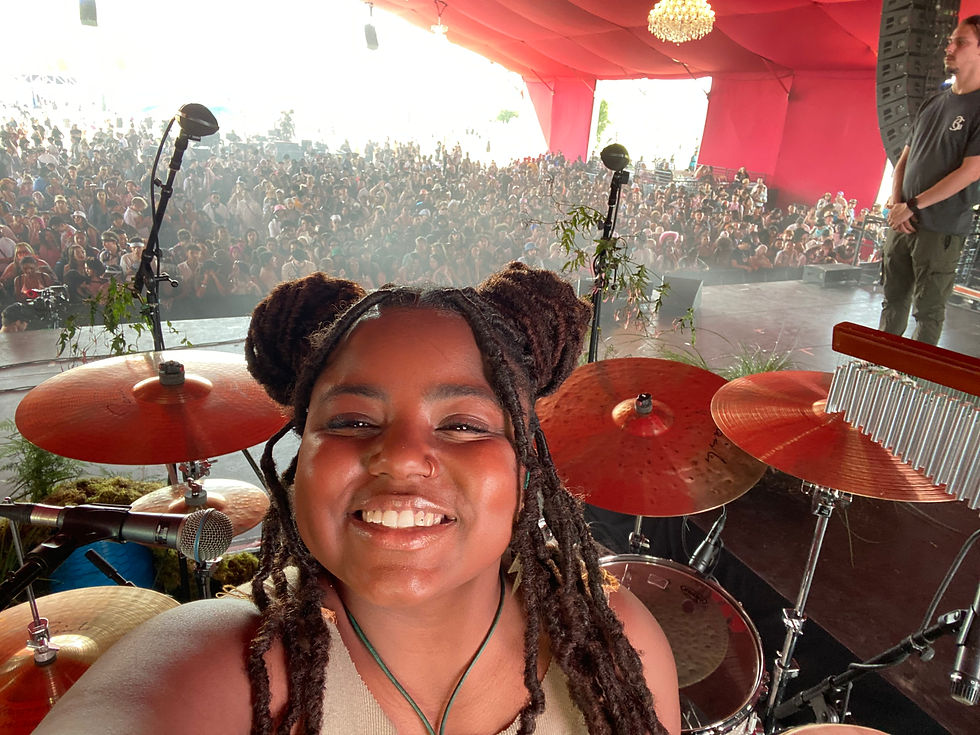
She is determined to evolve the drumming community by championing women in rhythm. "I think that there needs to be more women drummers," she states, with a dream to host clinics "so more young women can see that and be inspired to do it." She credits female legends like Sheila E. and former Beyoncé drummer Cora Coleman, alongside a vibrant circle of talented friends, as her core inspirations.
Her advice to aspiring musicians is simple: "Keep going hard at what you do... Don't stop."
And after all the hustle, the gigs, and the miles, what's her favorite part of life on tour? "Eating," she smiles. "And being with the band, because we're like family, so we go explore and eat and try new foods. It's my favorite part."
Want to see Aisha kill it on the drums? Catch her on tour with UMI right now!
Copyright 2025 WAFFLE. Magazine All Rights Reserved.



Comments